
Dr. Tom Brimeyer is a Functional medicine practitioner and Thyroid Expert, who recovered from hypothyroidism and helped thousands of people permanently overcome hypothyroidism. He is an Author of and programs
 When it comes to exercise, there’s a lot that we don’t understand. While everyone is led to believe that exercise is something that is always beneficial for our health, if you suffer from hypothyroidism, then exercise can quickly become dangerous and pose a serious risk to your thyroid and health.
This has become a very serious problem because so many hypothyroidism sufferers are incorrectly and dangerously using exercise as a means of trying to control their weight.
You can’t blame yourself though because everyone, even your doctor who is supposed to actually know what is best for your health, tells you that you need to exercise to lose weight and get healthy. But, when nobody stops to actually look at and understand the physiology of the body and how exercise impacts your entire hormonal system (thyroid included) that’s when you end up getting yourself into big trouble.
Yes, I understand that society today is obsessed about weight loss and the ridiculous idea that simply losing weight is the solution to all of our health problems. If that were true then why are so many non-overweight people suffering from hypothyroidism, cancer, autoimmune disease, heart disease, and every other disease for that matter?
In fact, I work with a number of clients who are severely hypothyroid and underweight.
If we would take a minute to step back and look at the big picture then we could begin to see that exercise isn’t always healthy, and in fact, can be quite thyroid suppressive and dangerous to your health.
A large part of the problem can be attributed to our poor interpretation of research, lack of knowledge, and a lack of understand of the human body.
While I will cover some of the dangers of exercise as it relates to hypothyroidism a little later, I would like to ask you to open your mind so that you can understand how little we really do understand when it comes to exercise.
So, I’m going to discuss a couple of very common exercise myths just so show you how little we really do know.
Myth #1 – Exercise Improves Thyroid Function
If you look at the current research, a lot of people are incorrectly led to believe that exercise improves thyroid function. There are studies where they have taken blood samples immediately before and then immediately after exercise in order to analyze the amount of thyroid hormone in the blood. Many of these studies have found that some forms of exercise cause an increase in blood level thyroid hormone, and so they interpret this as evidence that exercise improves thyroid function.
It’s time to celebrate, right? Not quite…
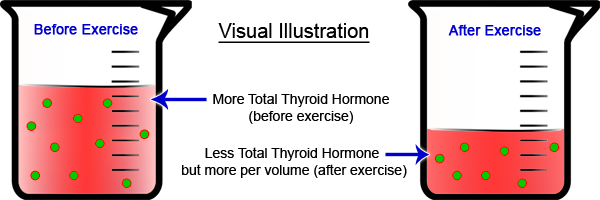
Using a basic understanding of cell physiology, when cells become fatigued or overworked, they take up more water. This is a natural response to stress. So, when you exercise, as your muscles fatigue, they can take up a significant amount of water. As water is pulled from your bloodstream and into your cells, this effectively decreases blood volume.
If blood volume is decreased then of course the concentration of thyroid hormone will increase but only because there is less blood and not because there is more thyroid hormone. If you to take this into account, the total amount of thyroid hormone actually decreases. And these researchers fail to account for this loss of blood volume that exercise causes.
There’s also a lot of research that demonstrates this as well.
For example, one mechanism that is well known is that stress, including exercise, inhibits the conversion of inactive T4 thyroid hormone to active T3 thyroid hormone by the liver…
The effect of acute exercise session on thyroid hormone economy in rats
http://joe.endocrinology-journals.org/content/198/2/347.abstract
“T3/T4 ratio was significantly decreased 60 and 120 min after the exercise, indicating impaired T4 to T3 conversion.”
And there are plenty of studies showing the negative effects of exercise on thyroid hormone as well…
The effect of exhaustion exercise on thyroid hormones and testosterone levels of elite athletes receiving oral zinc.
http://www.ncbi.nlm.nih.gov/pubmed/16648789
CONCLUSION: Findings of our study demonstrate that exhaustion exercise led to a significant inhibition of both thyroid hormones and testosterone concentrations…
And this one which also demonstrates a decrease in resting metabolism…
Endurance training with constant energy intake in identical twins: changes over time in energy expenditure and related hormones.
http://www.ncbi.nlm.nih.gov/pubmed/9160814
“Resting metabolic rate (RMR) was significantly decreased by 8% after training despite the preservation of fat-free mass (FFM). Accordingly, plasma norepinephrine (NE) concentrations, NE appearance rate, and plasma levels of triiodothyronine (T3), free T3, and total thyroxine (T4) were lower after training.”
There are lots of studies that show the same exact results, but I think you get the point.
Forcing yourself to exercise as a means of losing weight or trying to “boost” your metabolism can actually have the opposite effect and result in the further suppression of your thyroid, a slower metabolism, and ultimately more future weight gain.
Sounds kind of counter-productive, right?
Myth #2 – Running Burns More Calories than Walking
 This is one of my favorites because it goes to show you how far behind we are when it comes to our understanding of exercise and physiology.
The media, your doctor, your next door neighbor and everyone else who still has a bit of sanity left will tell you that running is one of the best ways to burn calories and lose weight?
Running is far better than walking, right?
Yes, you can read this in any exercise physiology book, but there’s something big that they’ve all forgotten to take into account…
Your brain!
When exercise physiologists study energy expenditure and derive their energy calculations, they fail to account for the brain in their calculations. And your brain produces huge amounts of energy and requires a huge amount of fuel.
Just because you’re running on a treadmill doesn’t mean that your brain shuts off and stops working. It’s still working and expending energy, just like your muscles.
Russian physiologists on the other hand are accounting for the brain. And by stimulating the brain and therefore increasing its energy expenditure, your brain can burn significantly more calories.
So, stimulating your brain while you walk can actually be more beneficial than running on a treadmill while your brain is minimally stimulated. If you take into account that walking would be far less damaging to your thyroid and metabolism, you can effectively support your thyroid and burn more calories on average from walking in a mentally stimulating environment than running while bored.
The bottom line is that our current understanding of exercise and physiology is severely lacking and it’s only further contributing to our general declining state of health today. And in today’s world, your thyroid really does need all the help it can get.
Millions of people today are not only hypothyroid, but are also making their hypothyroidism worse by following all of the bad advice out there. When millions of people are led to believe that something like exercise is always beneficial to their health, while it’s unknowingly causing more damage to their thyroid, then we really have an epidemic problem.
Hopefully this opens your eyes up to the fact that exercise, as it relates to hypothyroidism, is something that needs much more attention if we are ever going to make real progress in properly understanding and treating hypothyroidism.
How NOT To Exercise If You Have Hypothyroidism
 Exercising with hypothyroidism has been quite a misunderstood topic. Many people claim that exercise has huge benefits for people suffering from hypothyroidism. And some others tend to disagree. The truth is that exercise CAN have some amazing benefits BUT not all exercise is created equal. In fact, most forms of exercise will further damage your thyroid. But there are some very beneficial forms of hypothyroid exercise that have proven that they can be a very effective component of your hypothyroidism treatment plan.
And don’t forget to make your exercise even more effective by following the right hypothyroidism diet for even better and faster results.
I want to make sure that I make myself clear… Most forms of exercise are not beneficial and will only make you more hypothyroid.
This is because most forms of exercise cause excessive stress to your body.
Think about how exercise is supposed to work for a minute…
Almost all exercise is catabolic by nature, meaning that the stress of it causes your body to break down its own tissue. And it’s not until after this exercise that your body’s natural repair processes start up and your body recovers from the stress with the goal of rebuilding itself stronger than before.
But you have to realize that when you are hypothyroid, your body cannot properly recover from stressful exercise. So while you are hitting the gym thinking that you’re doing some great hypothyroidism exercise, you are continuously breaking down your body even more while your body fails to rebuild itself.
Eventually, your body breaks down to the point that if you’re lucky, you just run out of gas and you just can’t muster enough energy to make it to the gym. But more often than not, you end up with some sort of injury that sidelines your gym efforts.
And this is actually quite common due to the calcification of soft tissues that is one of the common hypothyroidism symptoms. But that’s a topic of another article.
Studies have also shown that these poor choices of hypothyroidism exercise cause your body to stop producing T3 almost immediately. And if that’s not an indication of a problem, then I don’t know what is.
I think that most people fail to realize that hypothyroidism is a respiratory problem. And without going into detail here, when you perform these types of poor hypothyroidism exercise, it forces your body to shift even further away from your healthy and thyroid supportive, oxidative energy system. And this makes you even more hypothyroid, which continues to carry over even after your workout.
So here I’ve listed some of the worse kinds of hypothyroidism exercise that you should be avoiding at all costs.
Cardiovascular Exercise
Personally, I think it’s absolutely ridiculous that so many people recommend cardio as a good form of hypothyroid exercise. And because people tend to push themselves to their limit when it comes to doing cardio, it makes it even worse.
Cardio exercise causes a chronic stress response from your body which is extremely catabolic. You might lose some weight but it’s most likely going to be from the breakdown of muscle tissue. And this process is not only stressful and inflammatory to your body, but it also contributes to hypothyroidism.
Any Form of Intense Exercise
I’ve seen a major shift in the exercise world which has been brought around mostly because cardio exercise doesn’t get results. And I think a large part of the problem really stems from the fact that most people are hypothyroid to begin with.
So, there’s been a major shift away from traditional cardio and to shorter and much more intense workouts. But this also has some major pitfalls, making it another poor hypothyroidism exercise choice.
When you’re hypothyroid, you already have a problem storing sugar in your liver. And these intense workouts require your body to use large amounts of sugar very quickly. And when this sugar isn’t available, then your body takes a beating. And again, this causes significant amounts of stress that leave you unable to recover and even more hypothyroid in the end.
How to Exercise Safely with Hypothyroidism
 Generally speaking, people don’t do well with moderation and complacency. Instead, people tend to have this obsession with extremes. We tend to live with a “more is better” type of mindset today.
People want to drive the fastest cars even though they are stuck driving 45 mph to work every day (72 kph for those of you on the metric system). People will spend twice as much for a TV that has a measly inch of extra viewing screen (2.54 centimeters). And in a similar fashion, people tend to want to exercise to the extreme as well.
Why?
Because people believe that if exercise is healthy then more exercise must be healthier, right?
Unfortunately, that’s not the way it works.
Nobody questions the fact that eating every day is necessary for health, but overeating is unhealthy.
So, why would exercise be any different?
Before you jump into your next Zumba class or set your sights on your next treadmill, first understand that exercise is a stress to your body. The longer and the harder you exercise, the bigger of a stress it becomes.
When you exercise, you are effectively forcing your cells to produce more energy and produce that energy faster. This means that you’re burning through more fuel and you’re burning through it faster as well. We already know that hypothyroidism sufferers don’t store fuel properly, which makes you even more susceptible to the stress of exercise.
Instead of relying on stored fuel during exercise to keep your cells happy, your body has to start pulling fuel from your bloodstream, which ultimately leads to low blood sugar. Forcing your body into a stress response due to low blood sugar is one of the many ways that exercise impairs thyroid function.
Of course that’s just a simplified overview of just one of the many ways in which exercise inhibits your thyroid. But it’s a big and very common one. And most people don’t even realize what they are doing to themselves.
Below we’ll look at 3 simple tips that you can use to help make exercise safe for your thyroid, including how to monitor your body’s response to exercise to ensure that it is safe.
1. Avoid Cardio, Aerobics, Intense, and Other Breathless Forms of Exercise
 It should make perfect sense that if you don’t want exercise to be a stress on your body and thyroid, then you have to stop the stress response before it happens.
When you do cardio, aerobics, or any other intense form of exercise where your body is not able to immediately meet the energy demands of the exercise, you are effectively causing a stress response in your body. When you become breathless, or find it difficult to catch your breath during exercise, this is a sign that your body doesn’t have enough oxygen available to support healthy energy production. Instead your body begins to compensate by shutting down your thyroid.
This is most common among those who do cardio or endurance forms of exercise that require sustained periods of energy production. And there are numerous studies that demonstrate the elevated stress hormone levels associated with this sort of endurance exercise…
Elevated hair cortisol concentrations in endurance athletes.
http://www.ncbi.nlm.nih.gov/pubmed/21944954
“These data suggest that repeated physical stress of intensive training and competitive races among endurance athletes is associated with elevated cortisol exposure over prolonged periods of time. These findings may have important implications with regard to somatic and mental health of athletes which should be investigated in future research.”
Salivary hormone and immune responses to three resistance exercise schemes in elite female athletes.
http://www.ncbi.nlm.nih.gov/pubmed/21572351
“Postexercise C (Cortisol) concentrations increased after all schemes, compared to control values (p < 0.05). In the SHS, the postexercise C response was also greater than pre-exercise data (p < 0.05). The current findings confirm that high-volume resistance exercise schemes can stimulate greater C (Cortisol) secretion because of higher metabolic demand.”
The results of these studies are not limited to athletes alone. In fact, if you are hypothyroid then it can take very little exercise to induce the very same stress response.
If we know that stress hormones suppress thyroid function and that cardio, endurance, or other breathless types of exercise increase stress hormone production, then it should make sense that these types of exercise are not conducive to healing your thyroid or improving your metabolism.
There are far more benefits to exercise than just burning calories or a way to lose weight. But to really take advantage of those benefits, you can’t overexert yourself.
Instead, take it easy and stop focusing on killing yourself in the gym. When you try to kill yourself in the gym, you literally are killing yourself. Generally speaking, when it comes to exercising with hypothyroidism, less is more.
2. Focus On Nutrition and Blood Sugar Regulation
 Now that you understand that something as simple as low blood sugar, induced by exercise, is enough to suppress your thyroid, it should also make sense that properly regulating your blood sugar is an integral part of offsetting the stress response of exercise.
A good place to start is by simply making sure that you’ve eaten something before exercising. Exercising on an empty stomach, especially first thing in the morning, is one of the fastest ways to elevate stress hormones and damage your thyroid.
3. Monitoring Your Temperature and Pulse
 I talk a lot about monitoring your temperature and pulse as an indicator of thyroid function and metabolism. You probably don’t realize that you can also use it to your advantage in measuring your body’s respond to exercise as well.
If you simply record your temperature and pulse before your workout, and then again 30 to 45 minutes (at rest) after your workout, you can tell you a lot about whether or not your workout was productive, or if it was counterproductive.
If your post-workout temperature drops after your body returns to its rested state, this is a telltale sign that your thyroid has been negatively affected. But you also need to account for other signs like fatigue, cold extremities, etc. This ultimately means that you need to go back to the drawing board and make some changes to your nutrition and exercise plan.
Sure, people love to step on the scale everyday as a way of measuring their results. But a positive shift in your scale is not an accurate indicator of a positive shift in your health. In fact, it can mean quite the opposite. So, instead of stepping on your scale, you should really be measuring your temperature and pulse. Those are far more accurate indicators of your state of health.
A lot of the issues associated with exercise today are really caused by our lack of knowledge and understanding of exercise and how it affects our physiology. So, instead of making the mistake of assuming that all exercise is healthy, and that the more you exercise the better, start monitoring your temperature and pulse and see for yourself if your exercise is really serving you and your thyroid well.
Instead of killing yourself in the gym, listen to your body and stop exercising when you become fatigued or your performance decreases. That really is your body’s way of telling you something.
And simply use some common sense. Exercise is not a proper means of relieving stress. As I’ve explained, it promotes stress. So, if you’re feeling stressed on a particular day, exercise is probably the last thing that your thyroid and body needs.
The Right Kind of Exercise To Support Thyroid Healing
The right kind of hypothyroidism exercise is very contradictory to the current exercise philosophy of working harder to get better results. In most cases, doing less is actually the key.
I’m going to give you three forms of exercise that are highly recommended for hypothyroidism. And this is because they are not catabolic in nature and do not work to break down your body.
Instead they promote and stimulate your body’s repair processes and create an anabolic, or tissue rebuilding, effect.
There are a few similarities between these three forms of good hypothyroidism exercise that I think are worth pointing out.
One of the biggest similarities is that they all place their primary focus on proper breathing. And this is far more important that you probably realize.
They do this because it’s the breathing techniques that they use which work to stimulate your healthy oxidative energy system. And without going into too much detail, this triggers your parasympathetic nervous system which is what promotes your body’s natural repair process.
And you’ll also notice that none of these forms of exercise are intense. Instead they are designed to focus on so much more than your muscles. They are balancing your energy system, your hormones, and so many other processes that work behind the scenes which are the true dictators of your health.
Instead of creating stress on your body, they are actually lower your stress level and hormones.
Below I’ve listed 3 great forms of hypothyroidism exercise. Find which one resonates with you the most and use it to your advantage.
Tai Chi
 I’m a huge fan of Tai Chi and I think its benefits speak for itself.
I’ve mentioned many times that thyroid function decreases with age and that many of the health problems common among the elderly community are in fact a result of hypothyroidism.
And I think that the testament to the effectiveness of Tai Chi can be seen in the amazing success that it has been providing the elderly community. It’s slowly gaining ground with this age population but the results speak for themselves.
Also, consider the fact that as you age, your body’s healing processes slow down. So, if it’s this effective with the elderly, then imagine how effective it can be for the younger population.
Qigong
Qigong is another great type of hypothyroidism exercise. I understand that there are many differences between Tai Chi and Qigong, but for all intensive purposes I would say that they are similar in nature and the results that they provide.
Tai Chi tends to be more structured whereas Qigong is freer flowing.
I definitely recommend trying them both and finding which one you find you enjoy more.
Yoga
 Yoga for hypothyroidism is one form of hypothyroidism exercise that you have to be a little more careful about. And that’s because there are many different forms and practices of yoga and not all are created equal.
You really want to stick with a less intensive form that focuses heavier on breathing and flexibility as opposed to many forms that are much more intense.
Again, I cannot stress enough the importance of using the right kind of hypothyroidism exercise as part of your treatment for hypothyroidism. It can really help accelerate your results and health to new levels.
Where To Get More Information
Thyroid expert, Dr. Tom Brimeyer has a that covers in so more detail exactly how exercise suppresses your thyroid and exactly what you MUST do to make exercise safe for your thyroid and boost your metabolism in the process.
If you want to learn the only safe way to exercise with hypothyroidism, then you definitely want to watch this which is a huge eye opener for many hypothyroidism sufferers.
Copyright © 2012 OutsmartDisease.com All rights reserved. You are not allowed to copy, re-print or resell this report. Content was provided to the Thyroid blog OutsmartDisease.com and some parts of the this report were re-printed with permission of the copyright owner.